Google Ads vs Meta Ads vs SEO: Which Digital Marketing Channel Should Your Business Choose?
Choosing the right digital marketing channel is an important decision for any business looking to improve its online presence, attract potential customers, and generate consistent enquiries. With several platforms available, business owners often face one common question: Should we invest in Google Ads, Meta Ads, or Search Engine Optimisation (SEO)?
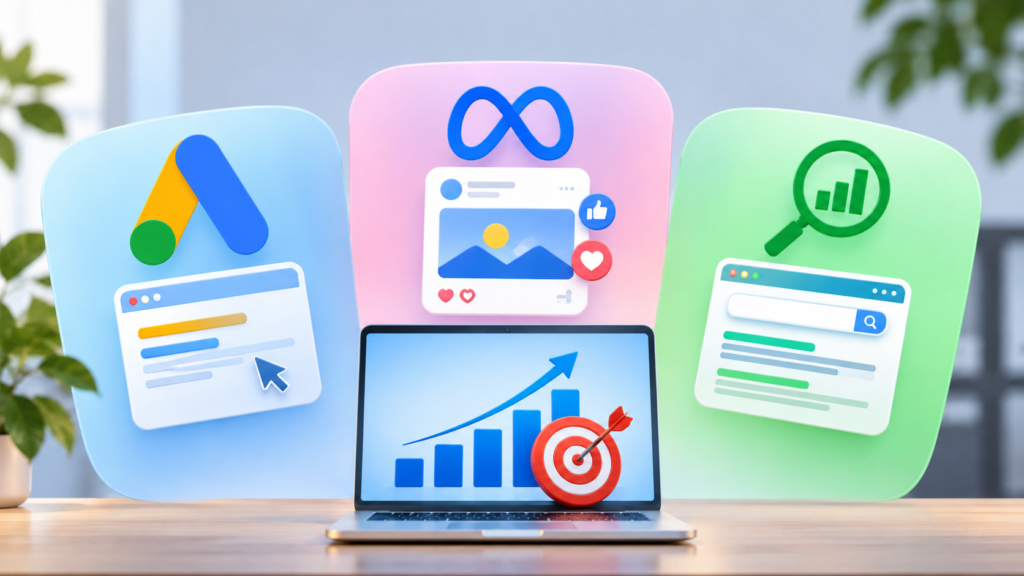
Each channel has a different purpose. Google Ads helps businesses reach people actively searching for products or services. Meta Ads introduces brands to audiences through social media platforms such as Facebook and Instagram. SEO improves a website’s organic visibility on search engines and supports long-term online growth.
However, there is no single channel that works best for every business. The right choice depends on your target audience, industry, marketing objectives, customer journey, and business requirements.
In this guide, we will compare Google Ads, Meta Ads, and SEO, explain their advantages and limitations, and help you identify the right digital marketing approach for your business.
Understanding the Three Digital Marketing Channels
Before comparing these channels, it is important to understand how each one works.
1. What Are Google Ads?
Google Ads is Google’s online advertising platform that allows businesses to display advertisements across Google Search, YouTube, partner websites, and other placements.
Search campaigns are particularly useful for reaching people who are already looking for a specific product, service, or solution.
For example, someone searching for “best digital marketing agency in Coimbatore” may see relevant sponsored search results. A business offering digital marketing services can use Google Ads to reach this potential customer.
Key benefits of Google Ads:
- Reaches users with specific search intent.
- Provides visibility for competitive search terms.
- Supports location-based and audience targeting.
- Allows businesses to track clicks, calls, and website conversions.
- Offers flexibility in campaign optimisation.
- Helps generate enquiries from people actively searching for solutions.
Google Ads is particularly suitable for businesses that want to reach customers who already understand their requirements and are searching for a provider.
2. What Are Meta Ads?
Meta Ads is the advertising platform for Facebook, Instagram, Messenger, and other Meta placements. Unlike search advertising, Meta Ads primarily helps businesses reach people based on audience characteristics, interests, behaviours, and interactions.
For example, a clothing brand can display its latest collection to users interested in fashion, lifestyle, and shopping. A restaurant can promote its menu, special dishes, and dining experience to people in selected locations.
Key benefits of Meta Ads:
- Reaches audiences based on interests and behaviours.
- Helps introduce products to potential customers.
- Supports image, video, carousel, and story advertisements.
- Builds brand awareness and audience engagement.
- Enables remarketing to people who previously interacted with a business.
- Supports website visits, lead generation, and sales campaigns.
Meta Ads is useful when businesses want to create demand, introduce new products, promote offers, or build stronger relationships with potential customers.
3. What Is SEO?
Search Engine Optimisation (SEO) is the process of improving a website’s visibility in organic search engine results. It involves optimising website content, technical performance, structure, and authority to help search engines understand and rank relevant pages.
For example, when someone searches for “industrial packaging manufacturers in Tamil Nadu”, a well-optimised website may appear in the organic search results if its content is relevant and useful.
Key benefits of SEO:
- Builds long-term organic search visibility.
- Helps attract users actively researching products and services.
- Improves website structure and user experience.
- Builds brand credibility through relevant search presence.
- Supports local business discovery.
- Creates opportunities to attract relevant website traffic over time.
SEO is a suitable approach for businesses that want to establish a stronger digital presence and attract organic visitors consistently.
Google Ads vs Meta Ads vs SEO: Key Differences
Although all three channels support business growth, their methods, audience targeting, and expected outcomes are different.
Comparison Factor | Google Ads | Meta Ads | SEO |
Primary purpose | Capture search demand | Create awareness and demand | Build organic visibility |
Audience targeting | Keywords, location and audience signals | Interests, behaviours and demographics | Search intent and relevant queries |
User intent | Often high purchase or enquiry intent | Often discovery and consideration | Informational, commercial or transactional |
Content format | Search ads, display and video | Images, videos, carousels and stories | Website pages, blogs and resources |
Traffic type | Paid | Paid | Organic |
Visibility | While campaigns are active | While campaigns are active | Built through ongoing optimisation |
Best suited for | Immediate search visibility | Brand awareness and product discovery | Long-term search presence |
Measurement | Clicks, leads and conversions | Reach, engagement, leads and sales | Rankings, organic traffic and conversions |
The biggest difference is how each channel connects with potential customers. Google Ads captures existing demand, Meta Ads helps generate interest, and SEO builds visibility when people search for relevant information or solutions.
Which Channel Is Best for Different Business Goals?
The best channel depends on what your business wants to achieve. A business looking for immediate enquiries may need a different approach from a brand focused on long-term visibility.
Google Ads: Best for High-Intent Leads
Google Ads is a strong option when potential customers are already searching for a particular service or product.
It can be especially useful for:
- Healthcare providers targeting people searching for specific treatments.
- Educational institutions promoting admissions.
- Manufacturers reaching buyers searching for industrial products.
- Service businesses looking for local enquiries.
- E-commerce stores targeting product-related searches.
For example, a company offering website development services can target relevant search terms to reach people actively looking for a website development partner.
However, campaign success depends on keyword selection, advertisement relevance, landing page quality, and conversion tracking. Sending visitors to an unclear or poorly designed page can reduce campaign effectiveness.
Meta Ads: Best for Brand Awareness and Product Discovery
Meta Ads is useful when businesses want to introduce their products or services to people who may not be actively searching for them.
It works particularly well for:
- Fashion and lifestyle brands.
- Restaurants and food businesses.
- Beauty and personal care products.
- Consumer electronics and retail.
- Events, promotions, and product launches.
- Ecommerce businesses with visually appealing products.
Creative quality plays an important role in Meta advertising. Attractive images, engaging videos, clear messaging, and relevant calls to action can encourage users to explore a brand.
Businesses should also monitor audience quality and actual conversions rather than judging campaign performance only through likes, comments, or reach.
SEO: Best for Long-Term Organic Growth
SEO is valuable for businesses that want to attract visitors through relevant search queries without relying entirely on paid advertisements.
It is particularly suitable for:
- B2B and manufacturing companies.
- Professional service providers.
- Educational institutions.
- Healthcare organisations.
- Ecommerce websites.
- Businesses targeting local and regional customers.
A well-planned SEO strategy can include keyword research, technical optimisation, useful content, local SEO, and website performance improvements.
SEO requires consistent effort, and results depend on competition, website condition, content quality, and search engine developments. It should be treated as an ongoing growth strategy rather than an instant lead-generation solution.
Businesses can explore Byzero’s SEO services to understand how search optimisation can support their organic visibility.
How to Choose the Right Channel for Your Industry
Different industries have different customer journeys. Understanding how customers discover, evaluate, and purchase products or services helps businesses select suitable marketing channels.
Business Industry | Recommended Channel | Supporting Strategy |
Manufacturing | Google Ads and SEO | Product pages, technical content and B2B lead generation |
Healthcare | Google Ads and SEO | Treatment-related content and local search visibility |
Education | Meta Ads and Google Ads | Admission campaigns, videos and enquiry landing pages |
Restaurants | Meta Ads and Local SEO | Food photography, reels and location-based promotions |
Ecommerce | Meta Ads and Google Ads | Product campaigns, remarketing and SEO |
Real Estate | Meta Ads and Google Ads | Property videos, location targeting and lead forms |
Professional Services | Google Ads and SEO | Service pages, case studies and educational content |
These are starting recommendations rather than fixed rules. A manufacturing company may benefit from LinkedIn campaigns, while a restaurant may use Google Search campaigns to capture people looking for nearby dining options.
The channel selection should always reflect customer behaviour and business objectives.
Should Your Business Use All Three Channels Together?
Yes. For many businesses, combining Google Ads, Meta Ads, and SEO can create a more complete digital marketing strategy.
Each channel supports a different stage of the customer journey.
Example of an integrated marketing approach:
- Awareness: Meta Ads introduces your brand to relevant audiences through engaging creatives and videos.
- Consideration: SEO content helps interested users learn more about your products, services, and expertise.
- Conversion: Google Ads reaches people searching for your services and directs them to relevant landing pages.
- Remarketing: Meta Ads reconnect with users who previously visited your website or interacted with your business.
- Measurement: Analytics and advertising platforms help evaluate traffic quality, enquiries, and conversions.
For businesses planning an integrated approach, Byzero’s digital marketing services bring together SEO, paid advertising, social media, and content marketing strategies.
However, using all three channels without a clear plan can create unnecessary complexity. Each channel should have a defined purpose, target audience, performance indicators, and conversion goal.
Important Factors to Consider Before Selecting a Channel

Before investing in any digital marketing platform, evaluate the following factors:
- Business objective: Decide whether your priority is brand awareness, website traffic, qualified leads, online sales, or long-term visibility.
- Target audience: Understand where your potential customers spend time and how they search for solutions.
- Customer journey: Identify whether customers make quick purchasing decisions or require detailed research before contacting your business.
- Website readiness: Ensure your website has relevant content, clear service information, mobile-friendly design, and effective enquiry options.
- Conversion tracking: Set up appropriate tracking to measure form submissions, calls, purchases, and other meaningful actions.
- Content quality: Prepare relevant advertisements, landing pages, product information, and educational content.
- Performance evaluation: Review lead quality and business outcomes instead of focusing only on impressions, clicks,s or engagement.
A structured strategy helps businesses identify which channels are generating meaningful results and where improvements are required.
Common Mistakes Businesses Should Avoid
Even a suitable marketing channel may not deliver the expected results if campaigns are poorly planned or managed.
Avoid these common mistakes:
- Selecting marketing channels only because competitors are using them.
- Running advertisements without clearly defining the target audience.
- Using the same creative and messaging across every platform.
- Sending all advertising traffic to the homepage instead of relevant landing pages.
- Ignoring mobile website performance.
- Measuring success through likes and clicks without evaluating conversions.
- Expecting immediate SEO results.
- Stopping campaigns without analysing performance data.
- Failing to follow up with incoming enquiries.
Businesses should regularly review their marketing strategy and make improvements based on actual audience behaviour and conversion data.
Final Thoughts: Choose the Right Channel for Sustainable Business Growth
Google Ads, Meta Ads and SEO each offer different opportunities for business growth. Google Ads helps capture existing search demand, Meta Ads creates awareness and introduces products to new audiences, while SEO builds organic visibility and long-term search presence.
The right choice is not always about selecting one channel over another. It is about understanding your business objectives, customer behaviour, and marketing priorities.
For businesses looking to improve their digital presence, an integrated approach can connect brand awareness, customer discovery and lead generation into one structured strategy.
At Byzero Technologies, we help businesses develop digital marketing strategies that combine search engine optimisation, paid advertising, social media marketing and creative solutions. Explore our digital marketing and performance solutions to identify an approach that supports your business goals.
Frequently Asked Questions (FAQs)
1. Which is better: Google Ads, Meta Ads or SEO?
There is no universal winner. Google Ads is suitable for capturing active search demand, Meta Ads is useful for brand awareness and audience discovery, and SEO supports long-term organic visibility. The right choice depends on your business goals and target audience.
2. Can small businesses use all three marketing channels?
Yes. Small businesses can combine all three channels based on their objectives and available resources. A focused strategy with clear priorities is more effective than running multiple campaigns without proper planning.
3. Is Google Ads better than Meta Ads for lead generation?
Google Ads can attract people actively searching for a service, while Meta Ads can generate interest among targeted audiences. Both can generate leads, but lead quality depends on audience selection, campaign messaging, and the conversion experience.
4. How long does SEO take to show results?
SEO timelines vary depending on website condition, competition, content quality, and optimisation efforts. It generally requires consistent work over time, and businesses should monitor organic visibility, relevant traffic, and conversions.
5. Can Meta Ads help ecommerce businesses increase sales?
Yes. Meta Ads can help ecommerce businesses showcase products, reach relevant audiences, promote collections, and reconnect with previous website visitors. Product quality, creative content, audience targeting, and website experience influence campaign performance.
6. Should I invest in SEO if I am already running Google Ads?
Yes. SEO and Google Ads serve different purposes. Paid search can provide advertising visibility, while SEO helps build organic search presence. Using both can support a broader search marketing strategy.
7. How do I know which digital marketing channel is working?
Track relevant performance indicators such as qualified leads, conversion rate, cost per lead, organic traffic, sales, and lead-to-customer rate. Use analytics and advertising reports to understand which channels contribute to actual business outcomes.
Looking to choose the right digital marketing channel for your business? Connect with Byzero Technologies to plan a strategy aligned with your audience, industry, and growth objectives.
- The Importance of Responsive Design by a Web Design Company
- Why Mobile Marketing is the Future of Digital Marketing
- The Evolution of Influencer Marketing: From Popularity to Authenticity
- How Social Media Platforms and Websites are Evolving to Support Direct Purchases
- Discover the Rise of Voice Search and Optimizing Content for Smart Assistants
- AI-Powered Marketing: The Next Frontier of Personalized Customer Experiences
- The Role of Email Marketing in 2024
- Is Social Media Marketing Better for B2C or B2B Businesses?
- How to Use Content Marketing to Boost Brand Awareness
- Local SEO vs. Global SEO: Which One Is Right for Your Business?
- Social Commerce: How to Sell Directly on Social Media Platforms
- The Impact of Short-Form Video Content on Social Media Marketing
- How AI is Transforming Digital Marketing: Key Strategies for 2024
- How to Create a High-Converting Digital Marketing Funnel in 2024
- The Power of Video Marketing: How to Create Videos That Drive Results
- SEO vs. SEM: Which Strategy is Right for Your Business?
- Top Digital Marketing Trends to Watch in 2024
- White Hat vs. Black Hat SEO: The Ethics of Backlink Building
- The Impact of Social Media on Backlink Building
- 6 Benefits of Knowing Digital Marketing Effectively
- How to Build an Effective Social Media Marketing Plan from Scratch
- 6 Ways to Get Noticed on Instagram
- The Rise of Micro-Influencers in Digital Marketing
- Transforming Social Media Platforms into Sales Channels: A Digital Marketer’s Guide
- Tips and tricks to know how digital marketers optimize ads
- How Coimbatore Companies Can Perform Technical SEO Audits of Websites
- SEO Secrets for Driving Coimbatore Brands to the Top of Search Results
- The Role of Color Psychology in Website Branding
- Key Elements Every Brand Website Should Have
- Guide to Refresh Your Brand’s Online Presence Effectively
- Making Your Website Google-Friendly in 2024
- Choosing the Right Website Design Approach for Coimbatore Businesses
- Paid Marketing vs. Organic Digital Marketing
- Implementing Digital Marketing Tactics for MSME Growth
- How to Choose the Right Digital Marketing Agency in Coimbatore
- Insights into Effective E-commerce Design Principles
- Understand the psychology of design and how it influences consumer behavior online.
- Understanding the Power of Engagement Metrics in Google Ads
- A Comprehensive Guide to Google Ads for Small Businesses
- Meta Boosts vs. Meta Campaigns: What’s the difference?
- Tips to Converting Your Targeted Audience to Followers
- Tricks for Digital Marketing Success
- How to Develop a Digital Marketing Strategy
- Instagram Marketing Tips for Businesses
- Tips to Grow Your Website Traffic
- How to get your business the first page on google
- Why blog? The benefits of blogging in business and marketing.
- The Rise of Social Commerce and Its Influence on Branding Strategies in the Digital Age
- Tactics To Get Great Customer Reviews
- Scaling Your Startup: Digital Marketing Strategies for Growth
- The Power of Logo Redesign: How Brands are Boosting Their Future Prospects.
- Mastering SEO for Business: Essential Strategies to Drive Traffic
- Role of User Experience (UX) in Effective Web Design
- Role of Branding in Building Trust with Customers
- Future of Web Design: Innovative Technologies and Trends
- Importance of Website Speed in User Experience and SEO
- The Role of Typography in Effective Web
- How to Develop a Brand Voice and Tone as a Web Designer
- Brand Voice and Web Designer…
- Latest Web Design Trends to Follow in 2023
- How to Use Social Media to Build Your Brand
- Importance of Brand Storytelling in Building Emotional Connections with Customers
- Benefits of Consistency in Branding Across All Marketing Channels
- Do logos, logotypes, and symbols that classifies a company?
- Future of Branding in a Digital World: Trends and Predictions
- Role of Branding in Attracting High-Value Clients
- Importance of Responsive Web Design for Mobile Devices.
- Building a Brand Strategy that Aligns with Your Business Goals
- Mental Illness Among Social Media Pros
- Incorporating Ethical Principles into Logo Design for Business
- Understanding the Importance of Content Marketing in the Digital Age